

The Invisible Struggle: Why Mental Health Gets Lost in Our Heads
Our minds are extraordinary pattern-recognition machines – yet terrible filing systems. When we try to manage mental health through memory alone:
- Cognitive overload: The average person has ~6,200 thoughts daily (Queen’s University study)
- Emotional distortion: Recalling feelings through yesterday’s stress filters today’s perspective
- Pattern blindness: Like trying to see climate change through daily weather reports
This mental “clutter blindness” explains why 68% of therapy patients struggle to articulate their emotional patterns to clinicians (Journal of Clinical Psychology, 2024).
The Neuroscience of Ink: 3 Transformative Benefits of Writing
1. Clarity Through Concrete Expression
Writing converts abstract emotions into tangible data points. A 2025 UCLA fMRI study revealed:
- Handwriting activates the prefrontal cortex (rational thinking) 23% more than silent reflection
- Emotional vocabulary use reduces amygdala activation (fear center) by 17%
Example: “I feel anxious” becomes “My chest tightens every Tuesday before team meetings when John micromanages projects.”
2. Pattern Recognition = Power
Tracking creates emotional time-stamps that reveal:
- Circadian mood cycles (e.g., energy crashes at 3 PM)
- Trigger clusters (conflict with specific people/situations)
- Progress markers (80% of “bad days” now recover within 2 hours vs. 6 hours pre-journaling)
Why Structure Beats Blank Pages (And How Serelith’s Planner Helps)
Traditional journals often become:
❌ Emotional dumping grounds
❌ Inconsistent records
❌ Missed connection points
Serelith’s Mental Health Planner Insert bridges the gap with:
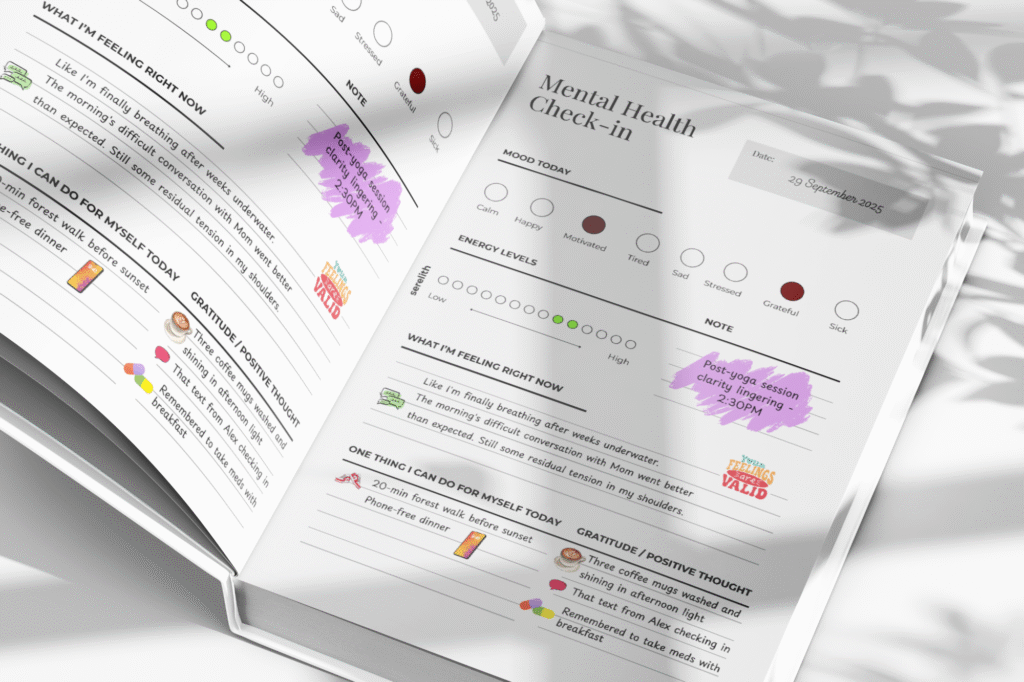
Key features:
- Guided mood mapping (1-10 scales with behavioral anchors)
- Trigger identification frameworks (“Was I HALT? – Hungry, Angry, Lonely, Tired”)
- Progress-tinted reflection prompts
- “What small win surprised me today?”
- “How did I handle stress better than 3 months ago?”
Your 28-Day Launch Plan (No Willpower Required)
| Day Range | Task | Time Commitment |
|---|---|---|
| 1-7 | Evening “3-Bullet Unload” | 2 minutes |
| 8-14 | Add morning intention setting | 90 seconds |
| 15-21 | Weekly pattern review | 8 minutes |
| 22-28 | Behavior-experiment planning | 5 minutes |
Pro Tip: Use the planner’s Emergency Unload Page when overwhelmed:
- Write stream-of-consciousness for 90 seconds
- Tear out and safely destroy the page
- Notice physical tension reduction
Your Brain Deserves Better Than Mental Guesswork
“What gets measured gets managed – and what gets written gets mastered.”
– Dr. Elena Torres, Cognitive Behavioral Researcher
Start Your Measured Journey Now →
Our Mental Health Planner Insert comes with:
✅ Laminated quick-guide bookmark
✅ 6 therapeutic writing prompt cards
✅ 12-month pattern analysis framework
P.S. Remember: This isn’t about creating perfect records – it’s about creating visible progress. Your first entry could be as simple as:
“Today I showed up. That counts.”