

You’re reading this at an hour you probably shouldn’t be working.
Maybe it’s 11 PM and you’re planning tomorrow’s impossible schedule. Maybe it’s 6 AM and you’ve already mentally exhausted yourself before breakfast. Maybe you opened this on your phone while pretending to relax on Sunday.
I know because I’ve been there.
And I need to tell you something that might sting a little: You’re not just tired. You’re burned out.
There’s a difference. And understanding that difference might be the most important thing you read this year.
THE TIRED VS. DEPLETED TEST
Let’s start with a diagnostic tool I created during my own recovery.
Tired is temporary. Depleted is systemic.
Here’s how to tell the difference:
SLEEP & REST
Tired says: “I need a good night’s sleep.” Depleted says: “I slept 9 hours and woke up exhausted.”
Tired says: “I’ll rest this weekend.” Depleted says: “I rested all weekend and Monday feels impossible.”
Tired says: “A vacation will help.” Depleted says: “I took a vacation and felt anxious the entire time.”
ENERGY & MOTIVATION
Tired says: “I need coffee to get started.” Depleted says: “No amount of caffeine helps anymore.”
Tired says: “I’m excited about this project, just need energy.” Depleted says: “I can’t remember the last time I felt excited about anything.”
Tired says: “I have low motivation today.” Depleted says: “I’ve had low motivation for months.”
DECISION-MAKING & FOCUS
Tired says: “I’ll make better decisions after I rest.” Depleted says: “I have decision fatigue by 10 AM every day.”
Tired says: “I’m a little distracted.” Depleted says: “I read the same paragraph five times and retained nothing.”
Tired says: “I need to focus better.” Depleted says: “My brain feels like it’s short-circuiting.”
If you’re scoring higher on the “depleted” side, keep reading.
THE HIGH-ACHIEVER’S BURNOUT PARADOX
Here’s what makes burnout particularly insidious for high-achieving women:
You didn’t fail your way into burnout. You ACHIEVED your way into it.
Every goal you crushed. Every deadline you met while sick. Every time you said “I’ll rest when this project is done.” Every boundary you sacrificed for “success.”
That’s how you got here.
And it’s why traditional productivity advice doesn’t work for burnout recovery. It’s like putting a bandaid on a broken bone.
THE SIGNS NOBODY TALKS ABOUT
Standard burnout lists mention exhaustion and cynicism. True. But here’s what they miss for high-achievers:
1. THE ACHIEVING-WHILE-DEPLETED CYCLE
You’re still hitting goals. Still meeting deadlines. Still appearing successful from the outside.
But internally, you’re running on fumes.
You’ve gotten so good at pushing through that you’ve lost the ability to notice when you should stop.
Red flag: You can’t remember the last time you worked at less than 100% capacity.
2. THE GUILT-REST COMPLEX
Every moment of rest feels like wasted time.
You’re “relaxing” while:
- Mentally planning tomorrow
- Feeling guilty about not working
- Scrolling your phone anxiously
- Telling yourself “I should be productive”
Red flag: You can’t rest without earning it first, and you never feel like you’ve earned enough.
3. THE DIGITAL HYPERVIGILANCE
Your phone isn’t in your hand—it’s practically part of your nervous system.
You check:
- Email within 5 minutes of waking
- Slack before you’re even out of bed
- Social media “just for a second” (30 minutes later…)
- Work notifications during dinner, weekends, vacations
Red flag: The thought of turning off notifications creates immediate anxiety.
4. THE DECISION FATIGUE CASCADE
Simple decisions feel overwhelming:
- “What should I eat for lunch?” (stares at menu for 15 minutes)
- “Which email should I answer first?” (answers none)
- “Should I go to this event?” (spends hours deliberating)
Red flag: You avoid making decisions by endlessly researching, asking others, or simply not deciding.
5. THE ACHIEVEMENT EMPTINESS
You hit a milestone you’ve been working toward for months/years.
Expected feeling: Pride, fulfillment, celebration Actual feeling: “Okay. What’s next?”
Or worse: “Is this all there is?”
Red flag: Success feels hollow instead of satisfying.
6. THE BODY REBELLION
Your body is screaming at you:
- Tension headaches that won’t quit
- Digestive issues that appeared from nowhere
- Sleep disruption (can’t fall asleep or can’t wake up)
- Getting sick more frequently
- Skin breaking out
- Hair falling out
- Menstrual cycle disruption
Red flag: You’re treating symptoms but ignoring the root cause (chronic stress).
7. THE ISOLATION PATTERN
You’ve started declining:
- Social invitations (“I’m too tired”)
- Family gatherings (“I have too much work”)
- Friend check-ins (“I’ll call them back later” – you don’t)
- Hobbies you used to love (“I don’t have time”)
Red flag: Your social circle has shrunk to work colleagues and your phone.
8. THE IRRITABILITY INCREASE
Things that never bothered you now trigger disproportionate reactions:
- A slow driver makes you rage
- A coworker’s question feels like an attack
- Your partner’s breathing is annoying
- You snap at people you love
Red flag: You’re not “just stressed”—your nervous system is dysregulated.
9. THE COGNITIVE FOG
You’re:
- Forgetting meetings you scheduled
- Losing track of conversations mid-sentence
- Reading but not comprehending
- Starting tasks and forgetting why
- Missing details you’d normally catch
Red flag: You’re joking about “brain fog” but it’s actually concerning.
10. THE EXISTENTIAL DREAD
Late at night (or early morning), you think:
- “What am I doing with my life?”
- “Why am I working this hard?”
- “Is this what success is supposed to feel like?”
- “I have everything I thought I wanted, so why am I miserable?”
Red flag: Achievement feels meaningless and you can’t remember what you actually want.
WHY YOUR PRODUCTIVITY SYSTEM IS MAKING IT WORSE
Now here’s the hard part.
If you’re like most high-achieving women in burnout, you’ve tried to “fix” it with:
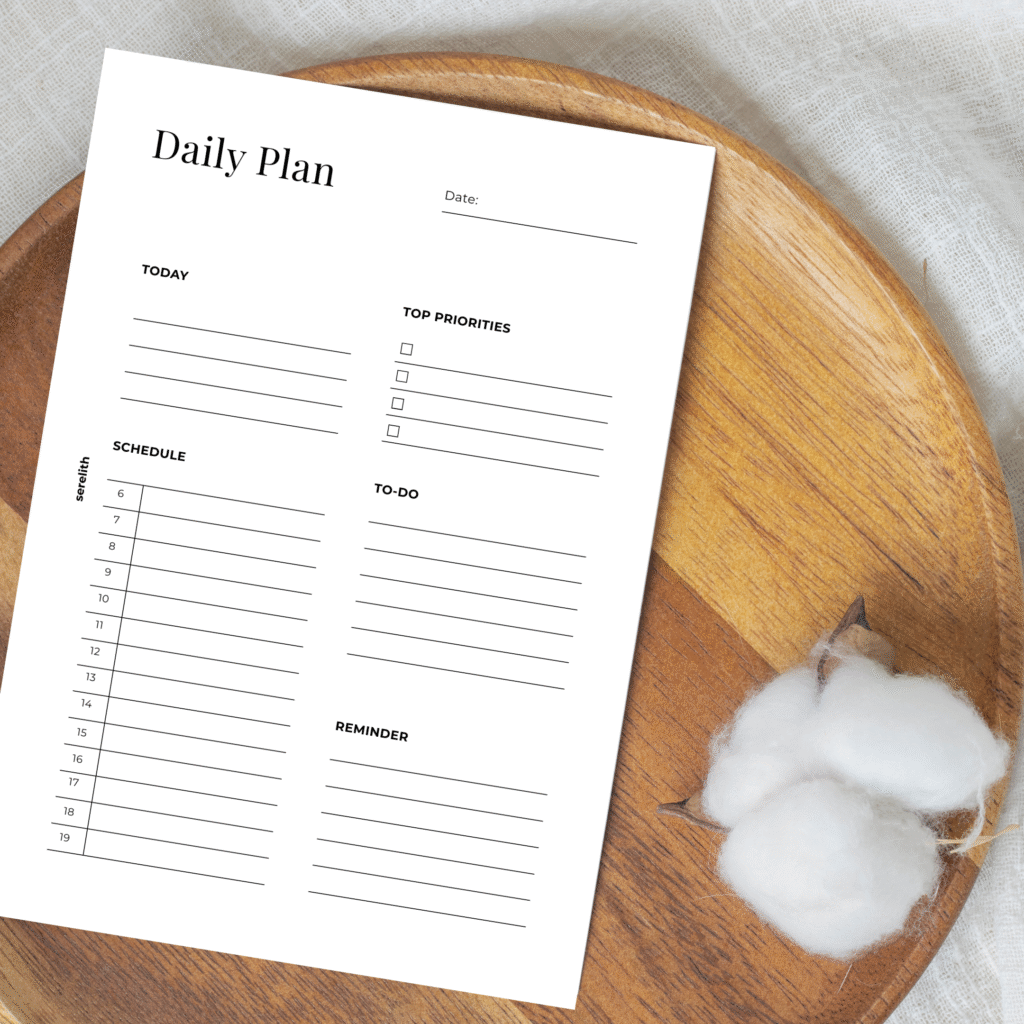
- A new planner
- A better to-do list system
- Productivity apps
- Time-blocking techniques
- “Just work smarter” advice
- Morning routines
- Evening routines
- Optimization strategies
And none of it worked.
Not because you’re doing it wrong.
But because burnout isn’t a productivity problem. It’s a nervous system problem.
THE PRODUCTIVITY-BURNOUT TRAP
Traditional productivity systems are designed for optimization.
They ask you to:
- Maximize output
- Minimize wasted time
- Track everything
- Measure everything
- Improve everything
- Do MORE, faster
But when you’re in burnout, you don’t need optimization.
You need REGULATION.
Your nervous system is stuck in fight-or-flight mode. Your body is in survival state. Your brain is protecting you by shutting down non-essential functions (like joy, creativity, and connection).
And productivity systems? They’re asking you to override those protective mechanisms and push harder.
It’s like trying to run a marathon with a broken leg.
WHAT YOU ACTUALLY NEED
Not another hack. Not another optimization. Not another “10 ways to be more productive.”
You need:
- Nervous system regulation (safety signals, not stress signals)
- Values alignment (goals that actually matter to YOU)
- Energy-based planning (working WITH your capacity, not against it)
- Contingency frameworks (because life happens and you need plans for it)
- Digital boundaries (your phone is hijacking your recovery)
- Intentional rest (as a practice, not a reward)
THE TURNING POINT
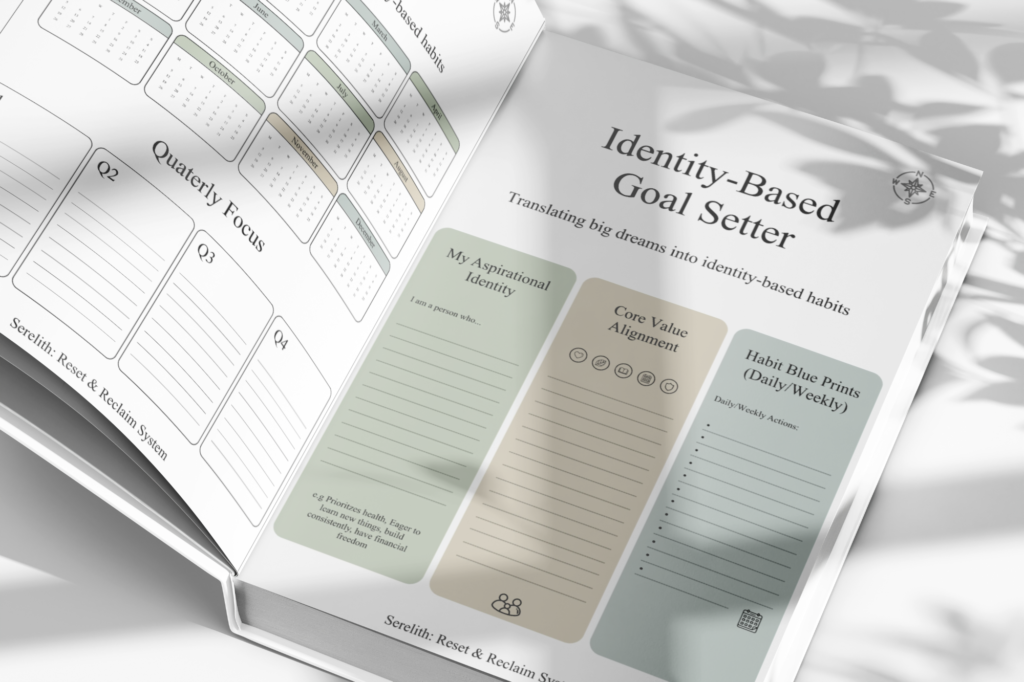
I created the Reset & Reclaim System after my own burnout.
Not as a productivity planner. As a recovery protocol.
It includes components like:
- Identity-based goal setting (who you’re BECOMING, not just what you’re achieving)
- Quarterly focus planning (90-day sprints, not 365-day overwhelm)
- If-then contingency frameworks (resilience as a practice)
- Digital minimalism audits (reclaiming attention from noise)
- Values compass alignment (ensuring your goals actually matter to you)
- Energy-based planning (honoring your capacity)
- Somatic rituals (nervous system regulation built in)
But before I talk about the system, I need you to acknowledge something:
You’re burned out.
Not lazy. Not weak. Not behind.
Burned out.
And that changes what you need.
WHAT TO DO RIGHT NOW
If you’re reading this and recognizing yourself in every paragraph, here’s what to do:
IMMEDIATE ACTIONS (Next 24 hours)
1. ACKNOWLEDGE IT
Say it out loud: “I’m burned out.”
Not “I’m just tired.” Not “I’m stressed.” Not “I need to work harder.”
“I’m burned out.”
2. STOP OPTIMIZING
Cancel that productivity webinar. Close the “10 ways to be more productive” article. Unsubscribe from the hustle-culture newsletter.
You don’t need more optimization. You need less.
3. IDENTIFY ONE BOUNDARY
Just one:
- No work email after 7 PM
- One device-free hour daily
- No meetings on Friday afternoons
- One day per week with zero plans
Pick one. Implement it tomorrow.
SHORT-TERM ACTIONS (Next 7 days)
1. TRACK YOUR ENERGY
Not your time. Your ENERGY.
For one week, note:
- When do you feel most depleted?
- When do you feel most alive?
- What activities drain you?
- What activities restore you?
Data over judgment.
2. PRACTICE MICRO-RESTS
You don’t need a vacation (though that would help).
You need 5-minute breaks throughout your day:
- Close your eyes and breathe
- Step outside
- Stretch your body
- Stare at nothing
- Drink water slowly
Set a timer. 5 minutes, every 90 minutes.
3. START SAYING NO
To one thing this week. Just one.
Not with excuses. Not with over-explaining.
“I can’t commit to that right now, but thank you for thinking of me.”
That’s it.
LONGER-TERM ACTIONS (Next 30 days)
1. AUDIT YOUR GOALS
Write down everything you’re currently working toward.
Then ask for each one:
- Is this actually MY goal, or someone else’s?
- Does this align with my current values?
- Am I achieving this from desire or obligation?
- Would I choose this if I were starting from scratch?
Delete anything that’s not a genuine yes.
2. REDESIGN YOUR PLANNING SYSTEM
If your current planner is asking you to optimize, maximize, and do more…
It’s time for a different approach.
(This is where Reset & Reclaim comes in, but I’ll save that for another post.)
3. GET SUPPORT
Burnout recovery isn’t something you have to do alone.
Consider:
- Therapist (especially one familiar with burnout)
- Coach (focused on sustainable success)
- Community (other high-achievers in recovery)
- Accountability partner (who understands you’re healing, not hustling)
THE PATH FORWARD
Burnout didn’t happen overnight. Recovery won’t either.
But it WILL happen if you:
- Acknowledge where you actually are
- Stop trying to optimize your way out
- Start building systems for regulation, not productivity
- Honor your nervous system’s need for safety
- Align your goals with your actual values
Over the next few weeks, I’ll be diving deeper into each component of sustainable recovery.
Next post: “Identity-Based Goal Setting: Why Outcome Goals Are Sabotaging Your Burnout Recovery”
But for now, I just need you to know:
You’re not broken. You’re not failing. You’re not behind.
You’re burned out.
And there’s a path back to yourself.
RESOURCES
Join the Conversation: Follow @serelith.store on Instagram for daily recovery insights
Get the System: The Reset & Reclaim System