

What if I told you that your goals are keeping you burned out?
Not because the goals are wrong.
But because the way you’re setting them is sabotaging your nervous system’s ability to recover.
Let me explain.
THE OUTCOME GOAL TRAP
Most goal-setting looks like this:
“I want to lose 100 kilograms.” “I want to make R100K this year.” “I want to get promoted.” “I want to write a book.”
These are outcome goals. And they have several problems when you’re in burnout recovery:
PROBLEM 1: THE FINISH LINE FALLACY
Outcome goals have a finish line.
Which means you’re either:
- Not there yet (failure)
- Or you’ve achieved it (now what?)
During burnout recovery, this binary creates constant shame:
“I’m not at my goal weight yet” = “I’m failing” “I haven’t written 50,000 words yet” = “I’m behind” “I’m not promoted yet” = “I’m not good enough”
Your nervous system interprets this as: Threat. Danger. Not safe.
And when your nervous system feels unsafe, it stays in fight-or-flight mode.
Which keeps you burned out.
PROBLEM 2: THE MOTIVATION MYTH
Outcome goals require sustained motivation.
“I’m going to work out 5 days a week!” “I’m going to write 1000 words every day!” “I’m going to network 3x per week!”
But here’s the thing about burnout:
You don’t have motivation. You have depletion.
So when you inevitably miss a workout (because you’re exhausted), you:
- Feel guilty
- Shame yourself
- Give up entirely
- Confirm your belief that you’re failing
This deepens burnout instead of healing it.
PROBLEM 3: THE WILLPOWER DRAIN
Outcome goals depend on willpower.
You force yourself to:
- Go to the gym even when exhausted
- Say no to the cookie even when stressed
- Work on the project even when depleted
But willpower is a finite resource.
And during burnout? It’s already depleted.
So outcome goals set you up for failure from the start.
THE IDENTITY SHIFT
Now let me show you a different approach.
Instead of: “I want to lose 20 kilos” (outcome goal)
Try: “I am a person who prioritizes health” (identity goal)
See the difference?
Let’s break it down:
IDENTITY-BASED GOALS ASK:
“Who am I becoming?”
Not what am I achieving. Not what am I doing.
Who am I BEING?
This shift changes everything.
HOW IDENTITY-BASED GOALS WORK
Let me give you a real example from my own burnout recovery.
OUTCOME GOAL VERSION:
“I want to exercise 5 days a week for 45 minutes.”
What happened:
- Week 1: Achieved it! (pride)
- Week 2: Missed 2 days (guilt)
- Week 3: Only went once (shame)
- Week 4: Gave up entirely (failure confirmation)
Nervous system message: “You can’t even stick to a simple goal. You’re failing. Again.”
IDENTITY GOAL VERSION:
“I am a person who moves my body with love.”
What happened:
- Day 1: 10-minute walk (success – aligned with identity)
- Day 2: Too depleted (rest – still aligned with identity because I honored my body)
- Day 3: 5-minute stretch (success – movement with love)
- Day 4: Dancing in kitchen (success – joyful movement)
- Day 5: Rest day (success – loving my body means rest too)
Nervous system message: “I’m safe. I’m honoring myself. Every action is success.”
See how different that feels?
THE IDENTITY-BASED FRAMEWORK
Here’s how to shift your goals from outcome to identity:
STEP 1: DEFINE YOUR ASPIRATIONAL IDENTITY
Ask yourself: “Who am I becoming in my recovery?”
Not who you were before burnout. Not who you think you should be. Not who your industry expects.
Who you’re becoming RIGHT NOW.
Examples of aspirational identities:
“I am a person who…”
- …builds consistently without burnout
- …prioritizes rest as productive
- …sets boundaries kindly but firmly
- …honors my energy levels
- …works sustainably
- …says no without guilt
- …creates from overflow, not depletion
- …values presence over productivity
Write 3-5 identity statements.
These should feel:
- Aspirational but achievable
- Aligned with your values
- Compassionate, not demanding
- Process-focused, not outcome-focused
STEP 2: ALIGN WITH CORE VALUES
Each identity statement should connect to a core value.
Let’s use an example:
Identity: “I am a person who honors my energy levels”
Underlying values:
- Self-awareness
- Sustainability
- Self-compassion
- Presence
- Health
If your identity doesn’t connect to a genuine value, it won’t stick.
It’ll feel like another “should” instead of a true becoming.
STEP 3: CREATE HABIT BLUEPRINTS
Now translate your identity into daily/weekly actions.
But here’s the key: These actions should have RANGE.
Not “work out 5 days a week for 45 minutes.”
But “move my body in a way that feels good, 3-7 days per week, for 5-60 minutes.”
Example:
IDENTITY: “I am a person who prioritizes deep work over busywork”
VALUES: Focus, quality, impact, sustainability
HABIT BLUEPRINTS (with range):
DAILY:
- 1-2 deep work sessions of 60-90 minutes
- Turn off notifications during focused time
- Start with most important task (not email)
WEEKLY:
- 1-2 hours of planning/reflection
- Audit calendar for alignment
- Say no to at least one shallow request
Notice the flexibility?
Some days you do 1 deep work session. Some days you do 2.
Both are success because both align with the identity.
IDENTITY-BASED GOALS DURING BURNOUT
Here’s why this approach is crucial for recovery:
BENEFIT 1: NO FAILURE STATE
With outcome goals:
- You either hit the target or you don’t
- Binary: success or failure
With identity goals:
- Every aligned action is success
- Spectrum: multiple versions of success
Example:
OUTCOME: “Write 1000 words daily”
- Wrote 1000 words = success
- Wrote 500 words = failure
IDENTITY: “I am a person who writes consistently”
- Wrote 1000 words = success
- Wrote 100 words = success
- Edited existing work = success
- Journaled about writing blocks = success
- Rested to restore creative energy = success
All of these align with the identity.
BENEFIT 2: SHAME-FREE ADAPTATION
Life happens. Energy fluctuates. Burnout recovery isn’t linear.
With outcome goals:
- Miss a day = shame spiral
- Lower the bar = “I’m failing”
- Adapt the goal = “I have no discipline”
With identity goals:
- Miss a day = “What does my identity need today? Maybe rest.”
- Lower the bar = “I’m honoring my current capacity”
- Adapt the goal = “I’m evolving. This is growth.”
Your identity can hold multiple expressions.
BENEFIT 3: INTRINSIC MOTIVATION
Outcome goals run on external motivation:
- Will this make me look successful?
- Will this impress others?
- Will this prove my worth?
Identity goals run on internal alignment:
- Does this reflect who I’m becoming?
- Does this honor my values?
- Does this feel true?
And during burnout recovery, intrinsic motivation is the only sustainable kind.
COMMON IDENTITY STATEMENTS FOR BURNOUT RECOVERY
Here are examples from women using the Reset & Reclaim System:
HEALTH & ENERGY:
- “I am a person who honors my body’s signals”
- “I am a person who rests without earning it first”
- “I am a person who moves with joy, not punishment”
WORK & PRODUCTIVITY:
- “I am a person who builds sustainably”
- “I am a person who prioritizes deep work over busyness”
- “I am a person who works in alignment with my energy”
BOUNDARIES & RELATIONSHIPS:
- “I am a person who sets boundaries with love”
- “I am a person who says no without guilt”
- “I am a person who protects my energy”
GROWTH & LEARNING:
- “I am a person who learns from failure without shame”
- “I am a person who grows gently”
- “I am a person who stays curious”
PRESENCE & MINDFULNESS:
- “I am a person who values presence over productivity”
- “I am a person who savors moments”
- “I am a person who lives intentionally”
CREATIVITY & EXPRESSION:
- “I am a person who creates from overflow”
- “I am a person who honors my creative cycles”
- “I am a person who makes space for play”
HOW TO IMPLEMENT (THE RESET & RECLAIM METHOD)
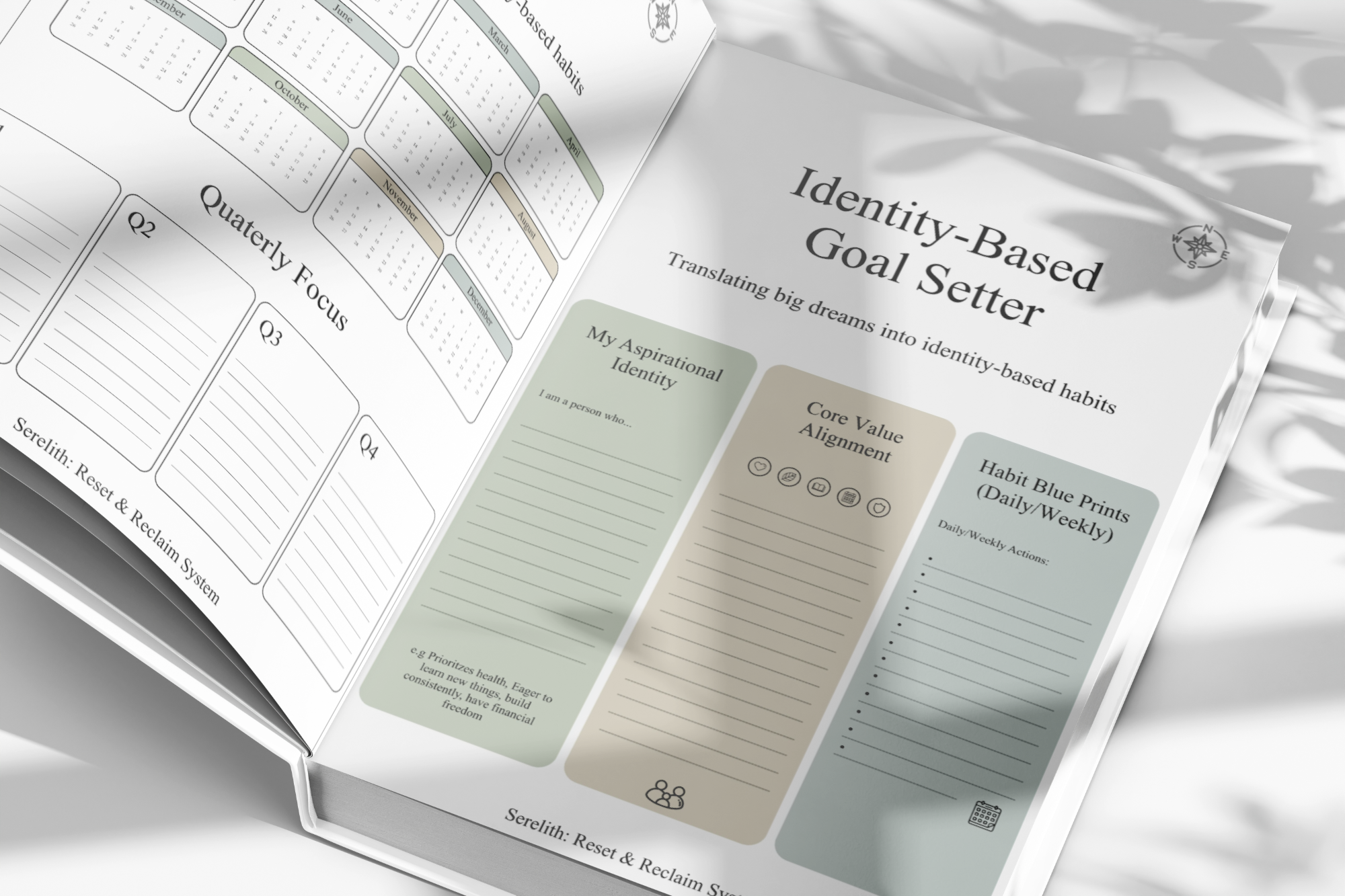
The Identity-Based Goal Setter in the system walks you through this:
SECTION 1: MY ASPIRATIONAL IDENTITY
“I am a person who…”
(Write 3-7 identity statements)
SECTION 2: CORE VALUE ALIGNMENT
For each identity, identify the underlying values:
- What does this identity honor?
- Why does this matter to me?
- What value does this reflect?
SECTION 3: HABIT BLUEPRINTS
For each identity, create daily/weekly actions WITH RANGE:
Not: “Exercise 5x/week for 45 minutes” But: “Move my body 3-7x/week for 10-60 minutes in ways that feel good”
Not: “Write 1000 words daily” But: “Write 100-1000 words 4-6 days/week”
Not: “Meditate 20 minutes every morning” But: “Practice presence 5-20 minutes daily (meditation, breath work, or silent sitting)”
The range allows for life. For fluctuating energy. For burnout recovery.
REAL EXAMPLE WALKTHROUGH
Let me show you a complete example:
IDENTITY STATEMENT: “I am a person who prioritizes deep, focused work over reactive busywork”
CORE VALUES:
- Impact (my work matters)
- Quality (I do things well)
- Sustainability (I don’t burn out chasing shallow tasks)
- Presence (I’m fully engaged with what I’m doing)
- Boundaries (I protect my time and energy)
DAILY HABIT BLUEPRINTS:
- Start my day with my most important task (before checking email)
- 1-2 deep work blocks of 60-90 minutes
- Turn off notifications during focused time
- Use “if-then” plans for interruptions
- End work at designated time (no 9 PM emails)
WEEKLY HABIT BLUEPRINTS:
- Sunday evening: Identify top 3 deep work priorities for the week
- Friday afternoon: Review what I accomplished (focus on quality, not quantity)
- Say no to at least 1-2 shallow requests
- Audit calendar: Does this week reflect my values?
- Protect 1-2 mornings for deep work (no meetings)
Notice:
- No specific numbers (“write 47 emails per day”)
- Range built in (“1-2 deep work blocks”)
- Values referenced throughout
- Gentle accountability (weekly review)
- Shame-free (every aligned action counts)
This person could:
- Do 1 deep work block one day (success)
- Do 2 deep work blocks another day (success)
- Have a day with zero deep work due to crisis (adapt without shame: “What does my identity need today?”)
All of it aligns with the identity.
WHEN IDENTITY GOALS FEEL TOO SOFT
I know what some of you are thinking:
“This feels too flexible. How will I achieve anything if I’m this gentle with myself?”
Fair question.
Here’s the truth:
Outcome goals got you burned out.
The “push harder, be strict, no excuses” approach is what depleted your nervous system to the point that you’re reading this article.
Identity goals rebuild your foundation.
So that when you DO pursue big goals, you do it from:
- Alignment (not obligation)
- Overflow (not depletion)
- Sustainability (not burnout)
You’re not lowering the bar. You’re rebuilding the ground beneath it.
YOUR ASSIGNMENT
If you’re ready to shift from outcome to identity:
TODAY:
Write one identity statement.
“I am a person who…”
Make it aspirational but achievable. Make it aligned with your values. Make it about who you’re BECOMING.
THIS WEEK:
Identify 2-3 daily actions that align with this identity.
Remember: RANGE.
“I do X for 10-60 minutes, 3-7 days per week”
Not rigid. Flexible.
THIS MONTH:
Live into the identity.
Notice how it feels to succeed multiple ways. Notice how shame decreases. Notice how your nervous system relaxes.
WHAT’S NEXT
This is the foundation.
But identity-based goals are just ONE component of the Reset & Reclaim System.
Next, I’ll show you how to combine this with:
- Quarterly focus planning (so you’re not overwhelmed by 12 months)
- If-then contingency frameworks (so obstacles don’t derail you)
- Values compass alignment (so your goals actually matter to YOU)
Next post: “The Quarterly Focus Method: Why 90-Day Sprints Prevent Overwhelm”
But for now, start with identity.
Who are you becoming?